Alaska Northern Lights: The Complete Guide
Alaska is vast, and only part of it is good for aurora viewing. Where in Alaska the northern lights actually appear, when the season runs, and why the interior beats the coast.
Alaska is roughly the size of western Europe, and the aurora does not treat it evenly. A traveler who flies into Anchorage, spends four nights on the coast, and goes home disappointed has not been unlucky. They have been in the wrong part of the state. Where you stand in Alaska changes your odds more than almost anything else you can control.
This guide covers the whole state: which regions genuinely work, which are oversold, when the season runs, and how to build a trip that does not depend on a single lucky night. If you already know you are heading for the interior, the Fairbanks tour guide is the more practical page.
Check Availability
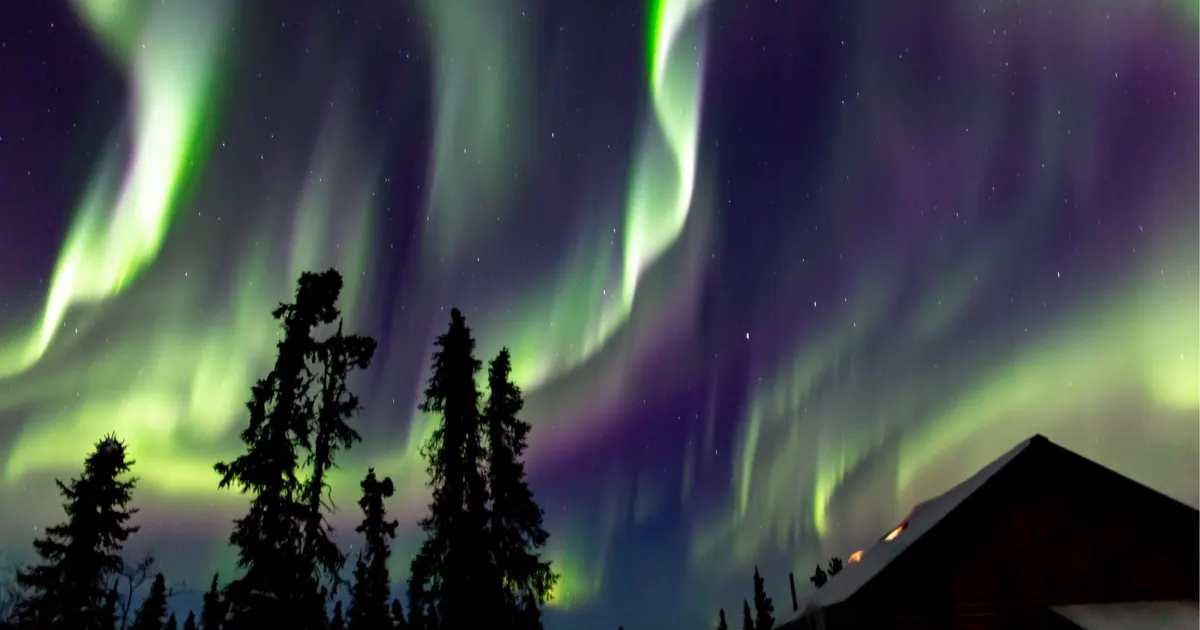
Why Alaska Works: The Geomagnetic Explanation
The aurora is not scattered randomly across the polar sky. It concentrates in the auroral oval, a ring of near-permanent activity centered not on the geographic North Pole but on the geomagnetic pole, which currently sits over northwest Greenland.
That offset is the whole story. Because the geomagnetic pole leans toward the North American side of the Arctic, the oval dips further south over Alaska and northern Canada than it does over Siberia. A location in interior Alaska sits underneath the oval at a geographic latitude where a Russian or Scandinavian equivalent would still be looking north at the horizon.
The practical measure is geomagnetic latitude rather than the number on a map. Fairbanks reads 64.84°N geographically but around 65°N geomagnetically, which puts it inside the oval. This is why Alaska punches above its latitude, and why the state’s aurora reputation is earned rather than marketed.
It also means the familiar advice about needing a big geomagnetic storm does not apply here. Under the oval, aurora appears at routine activity levels. Kp is a global index and a rough guide at best, but at Fairbanks even low readings of 1 to 2 can produce displays, and Kp 2 is an ordinary, frequent reading. The limiting factors in Alaska are darkness and cloud, not solar drama.
Where in Alaska to See the Northern Lights
Ranked by how reliably they deliver, rather than by how often they appear in travel listicles.
1. Fairbanks and the interior: the default answer
Fairbanks is the practical winner for most travelers, and not only because of its position under the oval. Three things stack in its favor.
It sits in Alaska’s continental interior, hundreds of miles from the Gulf of Alaska, which means genuinely dry air and a high proportion of clear nights. March is the clearest month of the year here. NOAA-normal data puts it at roughly 54 percent clear or lightly clouded, and it is also the driest month by precipitation.
It has infrastructure. A commercial airport with around twenty-three scheduled departures a day, a dense cluster of tour operators, rental cars, hotels with aurora wake-up calls, and gear rental shops that exist specifically to keep visitors warm for three motionless hours.
And it has usable dark sites within thirty minutes. Cleary Summit, around 20 miles north up the Steese Highway at about 2,230 feet (680 m). Chena Lake Recreation Area, around 17 miles out. Creamer’s Field, barely two miles from downtown. You do not need an expedition to escape the light dome.
Explore Fairbanks, the city’s official visitor body, states the aurora is visible an average of four nights in five when the sky is clear and dark enough, and that visitors staying three or more nights and actively watching late push their odds above 90 percent.
Our pick on GetYourGuide: the Northern Lights Tour with Free Photos from Arctic Night Tours, rated 4.8/5 across 250+ reviews, from $215. A small-group chase with no fixed route, heated transport, and guide-shot aurora portraits included. Our full breakdown of that tour covers the itinerary hour by hour.
Read next: best places to see the aurora near Fairbanks.
2. The Arctic Circle and Coldfoot: further north, harder work
Push north up the Dalton Highway and you cross the Arctic Circle at 66.56°N, reaching Coldfoot at roughly 67.25°N. You are deeper under the oval, with essentially no light pollution and a landscape that makes the photographs.
The trade-off is access. Coldfoot is around 260 miles from Fairbanks up a partly unpaved industrial haul road, and standard rental car agreements prohibit the Dalton Highway outright. A breach voids your coverage entirely. This is a fly-in or guided-tour destination, not a self-drive one, and you should treat any advice suggesting otherwise as a red flag about the source.
Worth doing for the crossing and the remoteness. Not a substitute for a Fairbanks base.
Our pick on GetYourGuide: the Arctic Circle Northern Lights Full-Day Trip from Fairbanks, rated 4.5/5 across 170+ reviews, from $330. It handles the Dalton Highway for you and includes the crossing certificate, with the aurora search built into the drive back. See our page on that trip for what the day actually looks like.
→ Arctic Circle trips from Fairbanks
3. Denali and the Parks Highway corridor: scenery first
The area around Denali National Park sits at roughly 63.5°N, still well positioned, with mountain foregrounds that are hard to beat photographically. Winter access is the catch: the park road closes to vehicles far short of the interior, most seasonal businesses shut down, and services thin out considerably between October and April.
Best treated as an addition to a Fairbanks trip rather than a base for one.
4. Anchorage: convenient, compromised
Anchorage sits at around 61.2°N, meaningfully further from the oval core than Fairbanks. Aurora does appear here, and during stronger activity it appears well. But two factors work against it: a large urban light dome, and a maritime position on Cook Inlet that brings considerably more cloud than the interior.
Anchorage is where most visitors land, and a great many treat it as an aurora base by default. If your trip is genuinely built around the lights, use it as a transit point and continue north, by air or on the Alaska Railroad’s Aurora Winter Train. The train runs mid-September to mid-May, northbound from Anchorage on Saturdays and southbound from Fairbanks on Sundays, departing 8:30 a.m. for a roughly twelve-hour, 358-mile journey. Extra midweek departures are added from mid-February through late March. Schedules change annually, so confirm with the railroad directly.
5. Remote western and northern Alaska: specialist territory
Nome, Kotzebue, and Utqiaġvik sit under or near the oval and offer genuinely dark skies, but all require expensive flights, have very limited tourism infrastructure, and are cold and exposed even by Alaskan standards.
Utqiaġvik carries a specific and under-reported complication: at around 71.3°N it can sit poleward of the auroral oval during quieter periods, meaning the aurora appears to the south rather than overhead, and can occasionally be less reliably visible than from locations further south. Further north is not automatically better. This is one of the most persistent misconceptions in aurora travel.
6. Southeast Alaska: the one to skip
Juneau, Ketchikan, and the Inside Passage sit at lower latitudes than the interior and, more damagingly, in a temperate rainforest with some of the heaviest cloud cover in North America. Aurora is occasionally visible during strong activity. As the basis for a trip, it is the weakest option in the state.
When to Go
The Alaskan aurora season runs from roughly August 21 to April 21, the dates Explore Fairbanks publishes for the interior.
Those dates are astronomical, not magnetic. The aurora is overhead year-round; it is simply invisible in summer because the interior has no true darkness. Around the June solstice Fairbanks receives close to twenty-two hours of daylight and the sun barely clears the horizon at night. There is no summer aurora viewing in Alaska, and any operator selling it is selling something else.
Within the season:
| Month | Darkness | Cloud | Temperature | Notes |
|---|---|---|---|---|
| August (from 21st) | Limited, improving | Moderate, ~62% overcast or mostly cloudy | Mild | Wettest month; short nights make it the weakest part of the season |
| September | Good | Moderate | Mild | Equinox effect; open water for reflections; comfortable |
| October | Good | Moderate to high | Cold | Freeze-up; transitional |
| November | Long | High | Very cold | Long nights, unreliable skies |
| December | Longest | High | Coldest | Only ~3.5 hrs daylight at solstice; severe cold |
| January | Very long | High | Coldest | Avg high near 1°F (−17°C), low near −17°F (−27°C) |
| February | Long | Improving | Very cold | Ice art season begins; skies clearing |
| March | Good | Best of the year | Cold but manageable | ~54% clear; driest month; equinox effect; strongest overall |
| April (to 21st) | Shortening fast | Good | Milder | Rapidly closing window |
The equinox effect deserves a note because it is both real and overstated. Geomagnetic activity does run statistically higher near the March and September equinoxes, a pattern described by Russell and McPherron in 1973, arising from how Earth’s dipole orientation makes a geoeffective southward interplanetary magnetic field more likely. It is a genuine elevation in the averages, not a guarantee for any particular night.
The honest conclusion: in interior Alaska, because you are under the oval, any clear dark night in season is a good night. Choose your month on cold tolerance, daylight for daytime activities, and what else is on. March gets the nod if you have a free choice, mostly on cloud statistics rather than magnetics.
Read next: best time to see the northern lights in Fairbanks, with the full month-by-month breakdown.
What About the Solar Cycle?
NASA and NOAA announced on October 15, 2024 that the sun had entered the solar maximum of Solar Cycle 25, earlier and stronger than the original 2019 forecast anticipated. Activity now declines gradually over the following years rather than stopping.
For aurora hunters in the lower 48 or in Britain, that decline matters a great deal: those mid-latitude displays depend on storms pushing the oval far south, and they will become rarer. For Alaska, it matters far less. A location under the oval does not need storm conditions to produce a display, which is why interior Alaska stays reliable through the quiet years of the cycle.
Anyone booking several seasons out should check NOAA’s Space Weather Prediction Center Solar Cycle Progression product, which supersedes anything written here.
Planning a Trip That Actually Works
Stay at least three nights. This is the single most effective thing you can do. The Explore Fairbanks 90-percent figure is explicitly conditional on a three-night minimum and on being outside during the late-evening hours. One night is a coin flip no matter where you stay or how much you spend.
Plan around the small hours. Aurora activity concentrates near magnetic midnight, close to 1 a.m. local time in winter, and the practical viewing window runs roughly 10 p.m. to 3 a.m. Build daytime plans that survive a 3 a.m. bedtime. This is the scheduling error that ruins more Alaska trips than weather does.
Get out of the light. Even a modest drive from a city center transforms a faint display from invisible to obvious.
Take the cold seriously. January in Fairbanks averages a high near 1°F (−17°C) and a low near −17°F (−27°C), and the city has recorded −66°F (−54°C). Clothing adequate for walking around a city at −4°F (−20°C) is not adequate for standing still for three hours at the same temperature. Some tour operators supply parkas, bibs, and insulated boots; others explicitly do not. Confirm in writing, and if you are not covered, Fairbanks outfitters rent exactly this by the day.
Understand what “guaranteed” means. Several Alaskan operators advertise aurora guarantees. In practice these are rebooking or partial-refund policies, and the qualifying bar is often lower than expected. One widely sold product treats the night as fulfilled if any aurora is visible by eye or camera, and a long exposure will capture a band your eye cannot register at all. Read the terms.
What It Will Actually Look Like
This is where expectations most often break.
In low light your eye relies on rod cells, which do not resolve color. A faint aurora therefore reads as a pale gray or greenish smoke-like band, often mistaken for cloud by first-time viewers. A camera on a long exposure gathers what your eye cannot, which is why photographs show vivid green, red, and purple that nobody standing there saw.
From roughly Kp 3 to 4 upward the green becomes clearly visible unaided. A strong substorm delivers obvious color and fast, structured movement across the sky that no photograph really conveys. The motion is the part that surprises people.
Both experiences are the northern lights. Arriving expecting only the second is the most common cause of disappointment.
Alaska Compared to the Alternatives
| Destination | Position | Skies | Access | Best for |
|---|---|---|---|---|
| Interior Alaska | Under the oval | Dry continental; among the clearest | Direct US flights; no passport for Americans | North American travelers wanting reliability |
| Tromsø, Norway | Under the oval | Coastal and cloudy; guides drive inland | Easy from Europe | Deepest tour infrastructure |
| Iceland | Slightly south of Tromsø magnetically | Maritime and variable | Very accessible from Europe and the US East Coast | Combining aurora with other landscapes |
| Yellowknife, Canada | Under the oval | Dry continental; excellent | Via Edmonton or Calgary | Direct comparison to Fairbanks |
| Abisko, Sweden | Inside the oval | Rain-shadow microclimate; statistically the clearest in Scandinavia | Via Kiruna; remote | Maximizing clear-sky odds |
| Rovaniemi, Finland | Just below the oval core | Cloudier | Easy via Helsinki | Families and glass-igloo comfort |
The consistent pattern: destinations that combine under-the-oval positioning with dry air (interior Alaska, Yellowknife, Abisko) beat coastal destinations on raw sighting frequency. Coastal Tromsø and Iceland compensate with dense tour infrastructure and aggressive inland chasing. For North Americans, Alaska adds the practical advantages of domestic travel.
→ Fairbanks vs Tromsø, Iceland and Yellowknife
Frequently Asked Questions
Where in Alaska is best for the northern lights?
Fairbanks and the surrounding interior, for a combination of reasons: position under the auroral oval, the driest and clearest skies in the state, dark sites within thirty minutes of town, and the infrastructure to support a winter visit. Coldfoot and the Arctic Circle go further north but are far harder to reach.
Can you see the northern lights in Anchorage?
Yes, but less reliably than in Fairbanks. Anchorage sits further from the oval core, carries a substantial light dome, and has a coastal climate with more cloud. Treat it as an arrival point rather than a viewing base.
Is further north always better in Alaska?
No. Utqiaġvik at around 71.3°N can sit poleward of the auroral oval during quiet periods, putting the aurora to the south rather than overhead. Being inside the oval matters more than being as far north as possible.
When is aurora season in Alaska?
Roughly August 21 to April 21. The dates are set by darkness, not by aurora activity. The lights are present year-round but invisible under the near-midnight sun of an Alaskan summer.
Can you see the northern lights in Alaska in summer?
No. There is no astronomical darkness in the interior between late April and late August.
How many nights do I need?
Three at minimum. Explore Fairbanks puts the odds above 90 percent for visitors staying three or more nights and actively watching during late-evening hours.
Do I need a strong solar storm?
Not in interior Alaska. Kp 2 puts active aurora over Fairbanks, and displays are possible at Kp 0 to 1 on clear dark nights. Darkness and cloud are the real constraints.
Is the aurora getting weaker now that solar maximum has passed?
Activity declines gradually from the October 2024 peak, and mid-latitude displays will become rarer. Interior Alaska is far less affected, because it does not depend on storms to bring the oval overhead.
Can I drive to the Arctic Circle myself?
Not in a standard rental car. Alaskan rental agreements generally prohibit the Dalton Highway and most gravel routes, and a breach voids your coverage. Take a tour or rent from one of the few companies that specifically authorize gravel highways.
Where to Go Next
If Alaska is settled and the question is now how, start with the Fairbanks northern lights tours guide. For timing, see best time to see the northern lights in Fairbanks. For specific viewing sites, see best places near Fairbanks.
Chase the Aurora From Fairbanks Tonight
Join 250+ travelers who rated this small-group northern lights tour 4.8/5. Expert local guide, heated transport, hot drinks, and professional aurora photos — all included. Free cancellation.
Check Availability & Book